







Frequently Asked Questions
Lorem ipsum dolor sit amet, consectetur adipiscing elit. Suspendisse varius enim in eros elementum tristique. Duis cursus, mi quis viverra ornare, eros dolor interdum nulla, ut commodo diam libero vitae erat. Aenean faucibus nibh et justo cursus id rutrum lorem imperdiet. Nunc ut sem vitae risus tristique posuere.
When should my child have their first dental visit?
We recommend that children have their first visit with a pediatric dentist around their first birthday. An early visit allows us to talk with parents about brushing, fluoride, diet, bottle and weaning habits, and how to care for those first little teeth.
Starting early also helps children become familiar and comfortable with the dental office before they ever need treatment.
At Dr. Lulu Pediatric Dentistry, we want your child's first dental experience to be positive, gentle, and fun.
When should I start brushing my baby's teeth?
As soon as your baby's first tooth appears!
Even one tiny tooth needs care. At first, parents can use a soft washcloth or an appropriate toothbrush and a very small amount of toothpaste.
We also use early visits to teach parents about fluoride, nutrition, home care, and ways to make brushing easier at home.
How often should my child see a pediatric dentist?
We generally recommend that children have regular dental checkups every six months.
Children grow and change quickly, so every visit gives us another opportunity to evaluate their growth and development, check for cavities, monitor how baby and permanent teeth are developing, and identify habits or other concerns that could affect their oral health.
Will my child do okay with dental treatment?
We expect your child to do great!
Every child is different, and we consider their age, personality, previous experiences, and the type of treatment they need.
Our approach is always realistic but optimistic. We explain expectations clearly to both parents and children and work together to create a positive experience.
Can I stay with my child during dental treatment?
Yes. Parents may accompany their child during treatment as long as they remain an observer unless our team asks them to participate.
We ask parents to allow our dental team to guide the conversation and avoid words that may create fear, such as "shot" or "hurt."
Our goal is for parents and our team to work together to build confidence and trust.
Why does my child need treatment on baby teeth if they are going to fall out?
Baby teeth are temporary, but they are very important.
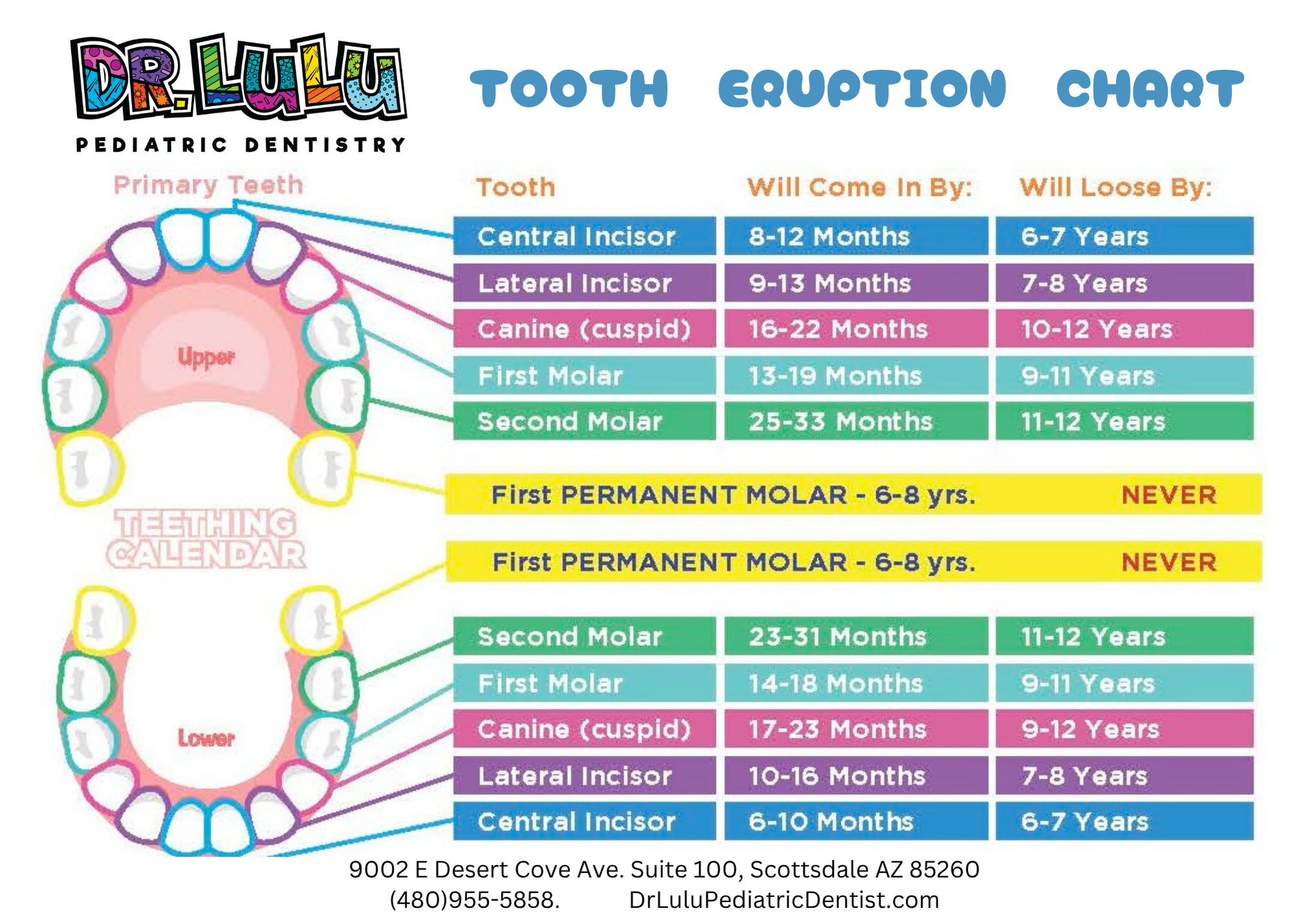
Primary teeth help children chew, speak, smile, and maintain the proper space and guidance for permanent teeth. Some baby molars remain in the mouth until approximately 11–14 years of age.
If a baby tooth is lost too early because of decay or infection, it can contribute to space loss and affect the eruption of permanent teeth. Treating a baby tooth when appropriate can help protect your child's oral health and development.
Will dental treatment hurt my child?
We do everything we can to make treatment as comfortable as possible.
For children who need local anesthesia, our team uses techniques such as topical anesthetic, positive reinforcement, distraction, and child-friendly language. We also avoid showing children the needle and use language designed to reduce anxiety.
Every child responds differently to dental treatment, and our goal is to help each child feel safe, understood, and confident.
Why are morning dental appointments recommended for young children?
Young children often cope better with dental appointments when they are well-rested and fresh.
For this reason, we generally prefer morning appointments for younger children. The training recommends appointments before noon for children under five, middle-of-the-day appointments for children over five, and after-school appointments for teens.
How long does a pediatric dental appointment take?
Appointment length depends on your child's age and the type of visit.
A new-patient appointment may take approximately one to one-and-a-half hours, while routine re-care visits are generally shorter. Treatment appointments are typically planned around the child's needs, with an effort to keep treatment visits to approximately one hour when possible.
Before your child's appointment, our team will let you know what to expect.
Why is my child's permanent tooth coming in behind the baby tooth?
This is a very common eruption pattern, particularly with the lower front teeth. We even have a cute name for it, Shark Teeth for boys and Mermaid Teeth for girls.
In many cases, the tongue naturally helps move the permanent tooth forward after the baby tooth becomes loose and falls out. However, we monitor the situation because this type of eruption can sometimes be associated with future crowding.
If the baby tooth does not become mobile, the permanent tooth is fully erupted, or a crossbite develops, your child's pediatric dentist may recommend treatment.
Does my child need dental sealants on their baby teeth?
Not always.
Sealants can help protect certain permanent teeth from cavities, but they aren't automatically recommended for every baby tooth.
Our pediatric dental team considers your child's age, tooth anatomy, ability to cooperate, oral hygiene, and individual risk for decay before recommending sealants.
Why can't we just pull a baby tooth instead of putting a crown on it?
If a baby tooth can be appropriately restored, keeping it may be important for your child's function, comfort, and developing permanent teeth.
Removing a baby tooth too early can result in space loss and may interfere with the eruption of permanent teeth. Depending on the tooth and your child's age, keeping the tooth with appropriate treatment may be a better option than extracting it.
We always discuss the reason for recommended treatment with parents so they can understand the long-term benefit for their child.
Is thumb sucking bad for my child's teeth?
It depends largely on your child's age and how long the habit continues.
Thumb sucking is very common in young children, and many children naturally stop between ages three and four. When the habit continues beyond this age, however, it becomes more important to address because it can affect permanent teeth and jaw development.
Our goal is to help families stop the habit in a positive and supportive way.
Is 7 or 8 years old too young for orthodontic treatment?
Not necessarily.
Some children benefit from an early orthodontic evaluation because certain dental, skeletal, or functional problems are easier to address while a child is still growing.
Examples can include severe crowding, crossbites, significant overjet, certain eruption problems, missing permanent teeth, and other developmental concerns.
An evaluation does not necessarily mean your child needs braces. It allows us to monitor growth and determine whether early intervention could be beneficial.
Does my child really need dental X-rays?
Dental X-rays can be an important part of a child's comprehensive dental examination because they allow us to see areas that cannot be evaluated by looking in the mouth alone.
We use X-rays based on your child's age, dental development, individual risk factors, and clinical needs. They can help us identify cavities between teeth, evaluate developing permanent teeth, and monitor growth and development.
Our goal is always to take the appropriate images when they are clinically necessary.
My child's front tooth turned dark after an injury. Is it dead?
Not necessarily.
A baby tooth can change color after trauma, and many primary teeth heal normally. After an injury, children may also experience gum swelling, bleeding, tooth mobility, or discomfort.
Because every injury is different, it is important to have your child's tooth evaluated by a pediatric dentist so we can monitor the tooth and surrounding tissues over time.
Does my child have “soft teeth” or weak enamel?
Not necessarily.
When a child has multiple cavities or dental problems, there can be many possible contributing factors. We look at the pattern and location of the decay, the appearance of the teeth, diet and home-care factors, and the child's dental development.
There are also certain inherited conditions that can affect enamel and tooth development. A pediatric dental examination can help determine what may be contributing to your child's dental concerns.
What are stainless steel crowns, and why does my child need one?
A stainless steel crown is a durable restoration commonly used to protect a baby molar that has significant decay or has required pulpal treatment.
When a tooth has lost a substantial amount of its structure, a filling may not provide enough support. A stainless steel crown can help restore the tooth's function and protect it from further breakdown while the tooth remains in the mouth.
For some children, keeping a primary tooth healthy until it is naturally ready to come out is an important part of protecting their developing permanent teeth.